We Analyzed 23 Popular Recipes: You Scroll Past ~1,300 Words to Reach the Recipe
Everyone jokes that online recipes bury the ingredients under a novel. We wanted a real number, so we measured it. We pulled 23 popular recipes from well-known food blogs and counted exactly how far you scroll before you reach the actual recipe.
The short version: on a typical recipe page, you read past about 1,300 words before you get to the ingredients. That is roughly six minutes of reading, for a list you could scan in fifteen seconds.
Everything below is free to use with attribution. The per-page numbers, the method, and a downloadable CSV are all here, so you can check our working or run it yourself.
Key findings
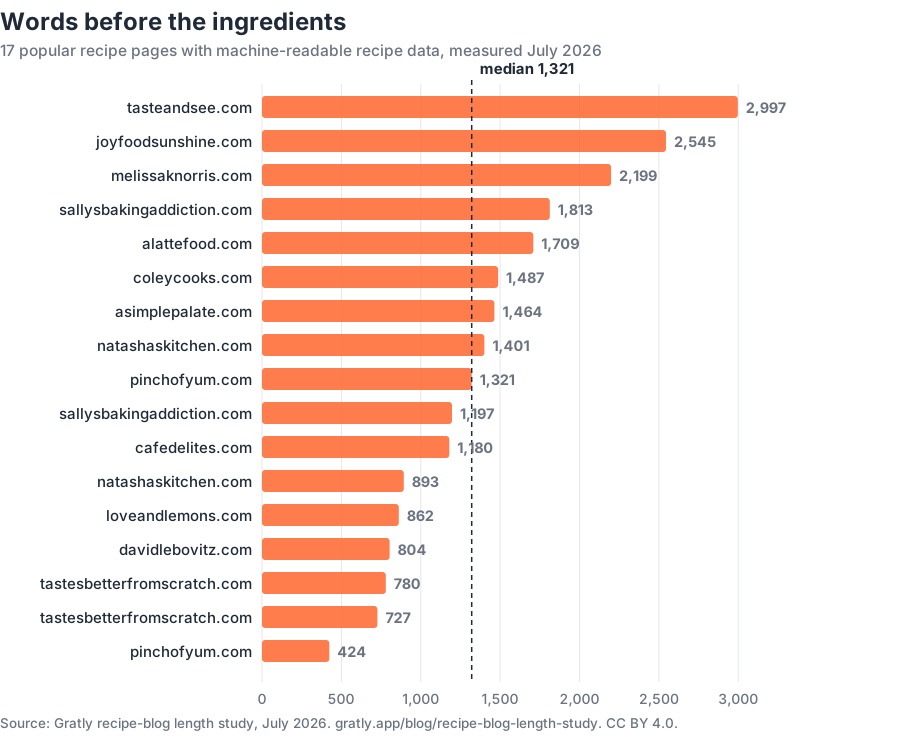
- The median recipe page put 1,321 words in front of the ingredients. The mean was 1,400.
- The longest intro we measured was 2,997 words. The shortest was 424.
- 65% of the pages we could measure had 1,000 or more words before the recipe. 18% had more than 2,000.
- 77% of pages added a "Jump to Recipe" button, a control whose only job is to skip the writing above it.
- The intro made up about half of all the text on the page at the median.
- The median page carried 184 references to ad and tracker domains, and 526 KB of HTML before a single image loaded.
The most telling stat: 77% add a "Jump to Recipe" button
More than three out of four of these pages include a "Jump to Recipe" button near the top.
Think about what that means. The sites themselves know most readers do not want the story. They built a control whose entire job is to skip the thing they just wrote, and they put it above the thing they wrote. That is not an accident or an oversight, it is an admission. The intro is there for search engines and ad inventory, and the button is there for you.
The full data
Every page we measured, with the numbers behind the aggregates above. "Words before" is how many words of visible text sit ahead of the first ingredient. Blank means the page did not publish machine-readable recipe data, so we could not locate the recipe reliably enough to count.
| Site | Dish | Words before | Total words | Jump button | Ad refs | HTML KB |
|---|---|---|---|---|---|---|
| tasteandsee.com | Chicken parm | 2,997 | 4,576 | Yes | 12 | 278 |
| joyfoodsunshine.com | Cookies | 2,545 | 4,493 | Yes | 208 | 510 |
| melissaknorris.com | Cookies | 2,199 | 4,367 | Yes | 189 | 610 |
| sallysbakingaddiction.com | Cookies | 1,813 | 3,176 | Yes | 269 | 557 |
| alattefood.com | Banana bread | 1,709 | 3,320 | Yes | 187 | 477 |
| coleycooks.com | Chicken parm | 1,487 | 3,406 | Yes | 210 | 733 |
| asimplepalate.com | Chicken parm | 1,464 | 2,877 | No | 168 | 445 |
| natashaskitchen.com | Chicken parm | 1,401 | 2,835 | Yes | 161 | 635 |
| pinchofyum.com | Cookies | 1,321 | 9,226 | Yes | 48 | 730 |
| sallysbakingaddiction.com | Banana bread | 1,197 | 3,174 | Yes | 267 | 560 |
| cafedelites.com | Pancakes | 1,180 | 2,138 | Yes | 161 | 575 |
| natashaskitchen.com | Banana bread | 893 | 1,809 | Yes | 223 | 500 |
| loveandlemons.com | Pancakes | 862 | 1,444 | Yes | 197 | 544 |
| davidlebovitz.com | Banana bread | 804 | 8,961 | No | 4 | 528 |
| tastesbetterfromscratch.com | Chicken parm | 780 | 2,032 | Yes | 238 | 627 |
| tastesbetterfromscratch.com | Banana bread | 727 | 1,444 | Yes | 235 | 586 |
| pinchofyum.com | Chicken parm | 424 | 1,682 | Yes | 40 | 269 |
| inspiredtaste.net | Pancakes | 4,668 | Yes | 225 | 424 | |
| blog.wilton.com | Cookies | 2,749 | Yes | 2 | 245 | |
| mostlyhomemademom.com | Pancakes | 2,375 | No | 0 | 64 | |
| laurafuentes.com | Pancakes | 2,273 | No | 182 | 525 | |
| daphneoz.com | Cookies | 840 | No | 1 | 118 | |
| cookiesfordays.com | Cookies |
The last row would not load for us at all, which is its own kind of data point.
Three things the numbers say that the headline does not
The intro is not padding around the recipe, it is the page. At the median, the words before the ingredients accounted for roughly half of all the text on the page. The recipe is not the main content with a preamble attached. It is the short bit at the end.
A long page is not automatically a buried recipe. davidlebovitz.com had by far one of the wordiest pages we measured, nearly 9,000 words of visible text, yet the recipe arrived after 804 words, well below the median. The rest is conversation happening after the recipe, which is a completely different thing from making you wade through it first. Length and burial are separate problems, and the sites that get accused of the first are not always guilty of the second.
Ad load and intro length are not the same axis either. tasteandsee.com had the longest intro in the sample at 2,997 words but only 12 ad and tracker references. sallysbakingaddiction.com had 269 references with an intro around the median. Some pages are long, some are heavy, and the worst ones are both.
How we measured this
To keep it checkable, here is exactly what we did.
- We collected 23 popular recipes from major food blogs across four dishes (banana bread, chocolate chip cookies, chicken parmesan, and pancakes) in July 2026.
- For each page we fetched the raw HTML with a desktop browser user agent, stripped
<script>and<style>blocks and all markup, and collapsed whitespace to get the visible text. - We located the recipe using the page's own structured data, specifically the first entry
in
recipeIngredienton itsschema.org/Recipeblock, and counted the words appearing before it. That is the "words before the recipe" figure. - We checked each page's HTML for the string "jump to recipe", and counted references to common ad and analytics domains (Google Ad Manager, DoubleClick, AdThrive, Mediavine, Raptive, Ezoic, Google Tag Manager, Google Analytics) as a rough proxy for ad and tracker load.
- 22 of 23 pages fetched successfully. 17 of those published recipe structured data we could use for the word count. So word-count figures are based on 17 pages, and the button, ad and page-weight figures on 22.
The analysis script is short, dependency-free Python, and we have published it too: recipe-blog-length-study-method.py. Point it at a different set of URLs and it will re-run the whole thing.
What this study does not show
Being straight about the limits, because they matter if you are going to quote it:
- It is a small sample, chosen for popularity, not randomly. 23 pages across four dishes is enough to show a pattern, not enough to characterise the whole web. Treat every figure as indicative.
- "Total words on the page" over-counts editorial length. It is all visible text in the HTML, which includes navigation, footers and comment threads. That is why one page reads as 9,226 words. The "words before the recipe" figure is much less affected, since comments sit below the recipe, but it still includes header and navigation text.
- We cannot compare pages with and without a Jump button. Only two pages in the measurable set lacked one, which is far too few to say anything about whether they run longer or shorter.
- Ad references are a proxy, not a count of ads. Counting domain strings in HTML approximates ad and tracker load. It does not tell you how many ad slots actually rendered.
- It is a snapshot. These pages get edited. Numbers measured in July 2026 will drift.
None of these caveats move the headline. The median recipe is a long way down the page, and the sites know it.
Why recipe pages are this long
It is not really about cooking. Longer pages have historically ranked better in search, and more words mean more room for ads. A bare list of ingredients also is not protected by copyright, so the surrounding story is partly there to make the page original enough to own. We wrote more about the mechanics in why are recipe blogs so long.
Worth saying plainly: this is a story about incentives, not about lazy or greedy writers. Food bloggers are responding rationally to how search and advertising pay them. The 77% figure is evidence that many of them would rather you got to the recipe faster too.
Use this data
This study is published under CC BY 4.0. Use the numbers, the table or the chart anywhere you like, including commercially, as long as you credit the source and link back.
- Raw data: recipe-blog-length-study-2026-07.csv — all 23 pages, one row each, including the URLs we measured.
- Chart: words-before-recipe.svg — free to embed.
- Method: recipe-blog-length-study-method.py — the exact script that produced the numbers, about 115 lines with no dependencies.
Cite it as:
Gratly (2026). Recipe Blog Length Study: how far you scroll before the recipe. Measured July 2026. https://gratly.app/blog/recipe-blog-length-study
Writing something and want a number we did not publish, or a cut of the data by dish or by site? Ask us. We would rather you quoted an accurate figure than estimated one.
The fix: skip straight to the recipe
You do not have to read any of it. Gratly is a free Chrome extension that turns any recipe page into just the recipe, in one click. No 1,300-word intro, no ads, no scrolling. It also gives you a cook mode that keeps your screen on, timers pulled from the steps, and serving scaling. It works on the sites we measured, and thousands more.
If you would rather not install anything, the "Jump to Recipe" button is on 77% of pages, and printing the recipe without the ads works on most of the rest.
FAQ
How long is the average recipe blog intro? In our sample of 23 popular recipes, the median was 1,321 words before the ingredients and the mean was 1,400. The longest was 2,997 words. At normal reading speed that is roughly six minutes before you reach the recipe.
What percentage of recipe blogs have a "Jump to Recipe" button? 77% of the pages we measured, 17 out of 22 that loaded. It is the clearest sign that the sites themselves expect readers to skip the writing.
Why do recipe blogs put the story first? Mostly for search rankings and ad revenue. A longer page has historically ranked better and has more room for ads, and a plain ingredient list cannot be copyrighted, so original writing around it makes the page defensible. Many sites add a "Jump to Recipe" button because they know readers want to skip ahead.
How much of a recipe page is the story? About half. At the median, the words before the ingredients accounted for roughly 50% of all the visible text on the page.
Can I use this data in my article? Yes. It is published under CC BY 4.0, the raw CSV is downloadable, and all we ask is a credit and a link to the study.
How do I get straight to the recipe? Use the "Jump to Recipe" button if there is one, or a tool like Gratly that strips the page down to just the ingredients and steps in one click.
Get just the recipe
Add Gratly to Chrome for free and never scroll past a 1,300-word intro again.
Related: why are recipe blogs so long, how to remove ads from recipe websites, and what to look for in a Chrome extension to save recipes.